Podcast: Play in new window | Download
Subscribe: Apple Podcasts | RSS
If you spend any time online looking for homeschooling advice, you’ve probably noticed that social media has split the community into two very loud, very extreme camps. It can feel almost impossible to figure out how to create a peaceful homeschool schedule when the algorithms constantly push you toward one of two conflicting lifestyles.
On one side, you have the “free-range,” ultra-crunchy mums who talk exclusively about the importance of play and letting the child take the lead. But if you watch their content for too long, there’s a subtle undercurrent of guilt; a heavy implication that if you introduce any formal structure or academics, you are somehow denying your child their childhood.
Important Links:
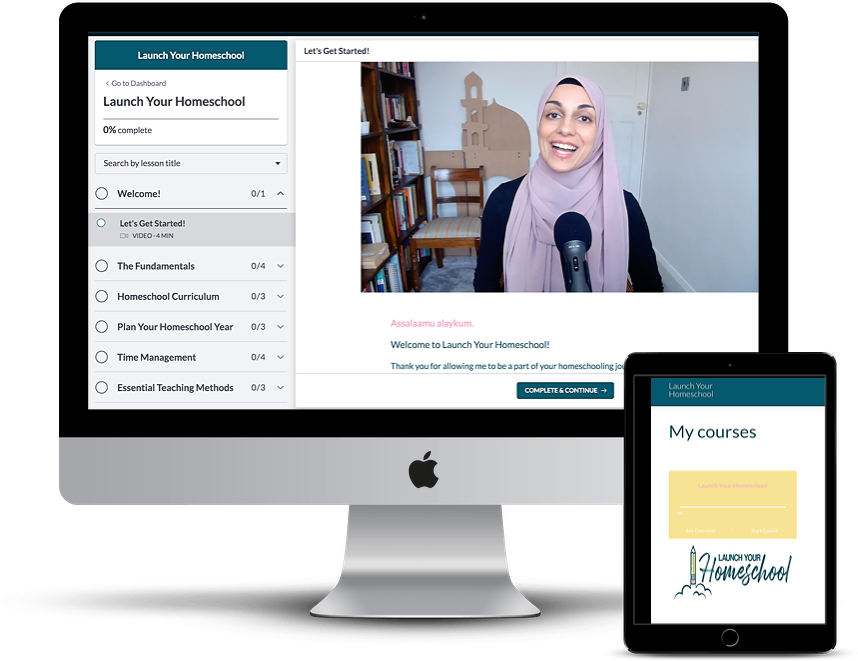
- ⭐️Click Here to join the WAITING LIST for Launch Your Homeschool: https://ourmuslimhomeschool.com/waiting-list ⭐️
- JOIN OUR EMAIL LIST: https://ourmuslimhomeschool.com/newsletter for weekly encouragement and tips.
- HOMESCHOOLING COURSES: https://ourmuslimhomeschool.com/courses to help you simplify your education journey.
- STATISTICS mentioned in this episode : https://www.itv.com/thismorning/articles/childrens-attention-span-is-shorter-than-ever-in-the-classroom
https://www.mirror.co.uk/news/politics/teachers-warn-kids-attention-span-30165916 - START A PODCAST with Blubrry:https://ourmuslimhomeschool.com/startyourpodcast . Get your first month of Blubrry podcasting hosting FREE with the affiliate code RaisingMums
- Intro Music – by PEARLS OF ISLAM: https://www.pearlsofislam.co.uk (Bismillah from the album “Love is My Foundation”)
- Follow me on Instagram:https://www.instagram.com/ourmuslimhomeschool/
- Subscribe on YouTube: https://www.youtube.com/@ourmuslimhomeschool

Then you scroll a bit further, and you hit the other camp. This side advocates for a rigid, highly structured, bookish approach. They have immaculate, color-coded schedules, and their message is just as intense: if you aren’t hitting every academic benchmark right on time, you are essentially guilty of educational neglect.
There is almost zero space for intelligent, nuanced dialogue on social media about this. In fact, platforms intentionally push this division because extreme views get more clicks, more engagement, and more eyes. No wonder you’re feeling a little confused, guilty, or completely paralyzed about how to actually get anything done in your homeschool!
Recently, I received a message from a homeschooling parent that cut right through all this online noise. It truly resonated with my heart:
“The area of homeschooling that I need most help with is creating a schedule where the flow of work is comfortable, yet still meets our goals and requirements for advancement.”
First of all, Jazak Allah khair for sending this in. If you are reading this right now and nodding your head, please know you are not alone. It is the ultimate homeschooling tightrope walk, isn’t it? We want that peaceful, loving home environment that honors childhood—not a stressful, tear-filled classroom. But we also have real goals, curriculums to finish, and the responsibility of ensuring our children advance.
How do we marry the two? How do we find that middle path that flows beautifully but still gets the job done?
The reason this middle path is so hard to find is that the moment we actually try to sit down and get that structured work done, we run into a major roadblock: our children’s focus.
We plan a beautiful lesson, but within five minutes, our child is daydreaming, resisting, or melting down. And in that moment of frustration, we feel forced into those social media extremes—we think we either have to become a rigid drill sergeant to force them through it, or give up entirely and become a completely free-range homeschooler.
But if you feel like your child is struggling to stay focused, I want to give you some major reassurance: it isn’t just you, and it isn’t a failure of your scheduling. It’s a massive societal shift.
Recent data from right here in the UK paints a staggering picture. A major study surveying primary school teachers in England revealed that a massive 84% of educators believe children’s attention spans are shorter than ever before. In fact, things have changed so drastically in modern classrooms that one in five teachers report they now have to cut lesson activities down to under 10 minutes just to keep pupils from completely tuning out. [1] [2]
Educators point the finger directly at our “ever-swiping” digital culture. When young brains are conditioned by fast-paced screens and instant rewards, sitting down for a long, traditional school lesson feels painfully boring to them. Their brains are being rewired to seek quick bursts of stimulation, which leads directly to daydreaming, restlessness, and frustration when it’s time to do desk work.
So, how do we combat this modern “attention crisis” without causing tears at the kitchen table?
We don’t do it by forcing them to sit still for hours or fighting against their biology; we do it by working with it. And to do that, we can look at some incredible tools inspired by the 19th-century British educator Charlotte Mason, who famously argued that “the lessons must be short, fresh, and varied” to keep a child’s mind truly alive.
The Power of Short Lessons for a Peaceful Homeschool Schedule
Isn’t it fascinating that modern UK teachers are cutting activities to under 10 minutes out of desperation, yet over a century ago, Charlotte Mason was already advocating for this exact strategy?
When we think of academic advancement, we often think we need to sit a child down for an hour of math or 45 minutes of grammar. But Charlotte Mason observed that a child’s sustained, intense attention is a finite resource. For younger children (around ages 6 to 9), she advocated for lessons lasting just 10 to 15 minutes. For older children, 20 to 30 minutes.
Now, you might think, “How can they possibly learn enough and advance in 15 minutes?”
Here is the secret: Habit training. When a child knows a lesson is short, they give it their absolute, undivided attention. They don’t have time to dawdle or get fatigued. A child who works with intense focus for 15 minutes will often accomplish more than a child who stares at a worksheet for an hour while crying.
The Productivity Science: Parkinson’s Law & Pomodoros
Think about how we operate as adults. You might have heard of Parkinson’s Law—the idea that work expands to fill the time we give it. If you give yourself three hours to clean the kitchen, it will take three hours. If you give yourself 30 minutes because guests are arriving, you’ll get it done in 30 minutes!
Children’s brains work the exact same way. If they see a massive, never-ending pile of worksheets, their brain slows down to stretch the work out. But if we use what modern productivity experts call the Pomodoro Technique: working in short, intense bursts followed by a break…the brain sharpens.
By keeping lessons short, you are essentially using a child-friendly Pomodoro timer. You prevent burnout and you preserve their love for learning.
And how do we advance? Through consistency. Fifteen minutes of focused math, five days a week, adds up to massive progress over a year.
But how do you transition between these short lessons without the day feeling chaotic? Miss Mason suggested alternating the types of brain cells being used. If you just did 15 minutes of intense mental math, don’t move straight to handwriting. Instead, follow math with something creative or physical, like a handicraft, a nature walk, or reading a beautiful poem. This variation acts like a breath of fresh air for their brains.
Morning Baskets & Loop Scheduling in a Peaceful Homeschool Schedule
If lessons are short, that means you can technically fit in more subjects, like poetry, picture study, Quran, history, and science. But how on earth do you fit all of that into a day without feeling rushed?
This is where two brilliant scheduling tools come into play: the Morning Basket and Loop Scheduling.
1. The Morning Basket
This is a practice where the whole family gathers at the start of the homeschool day to share in what Charlotte Mason called “the feasts of education.” Instead of everyone scattering to their separate workbooks immediately, you start together with beauty, faith, and connection.
In a Muslim homeschool, this is the perfect time for your:
- Morning Adhkar
- Quran recitation
- Stories of the Prophets
- Poetry or a family read-aloud
- A quick artist or picture study
The Morning Basket warms up everyone’s brains, grounds the day in the remembrance of Allah, and ensures that those “extra” subjects that feed the soul actually happen, comfortably, before the heavy individual work begins.
(Note: If you want to know more about the morning basket, I did a video years ago on YouTube that you can search up called “Our Muslim Homeschool morning basket.”)
2. Loop Scheduling
Once your Morning Basket is done, how do you handle the rest of the subjects without feeling chained to a rigid clock? You enter Loop Scheduling.
Traditional school schedules say: “It is Tuesday at 10:00 AM, so we must do History. If we miss it because we had an appointment, we are behind.” That rigid structure causes so much anxiety. Loop scheduling completely flips this. Instead of assigning a subject to a specific day and time, you create a list of subjects and simply “loop” through them in order.
Imagine your loop looks like this:
- History
- Science
- Geography
- Handicrafts
- On Monday: You do your core work (like Math and Reading), and then you look at your loop. You have time for History. Great! Check it off.
- On Tuesday: Life happens. A dentist appointment runs late, or the toddler has a meltdown. You only have time for core work, and you don’t even touch the loop.
- On Wednesday: You open your loop again. You don’t stress about what you missed on Tuesday. You simply look at the next item on the list, which is Science.
Do you see the absolute freedom in this? You are never “behind.” You simply pick up exactly where you left off. It guarantees that you will advance through all your subjects at a comfortable, natural flow, while giving you the flexibility to handle real life. (This is also something that I teach in-depth inside Launch Your Homeschool.)
A Peaceful Homeschool Schedule will fill their buckets!
Dear sisters, meeting your educational goals doesn’t require a rigid, drill-sergeant mentality. True academic advancement happens through the quiet, consistent accumulation of small, faithful efforts.
The wonderful homeschool author Cindy Rollins often talks about education using the metaphor of an old poem—reminding us that little drops of water and little grains of sand are what eventually make the mighty ocean and the pleasant land. She writes in her memoir:
“You are never going to have a lot of time, but you do have a little time here and a little time there, and those little times all add up to a life.”
Your homeschool day is made up of exactly that: little drops.
By using short lessons to build the habit of attention, grounding your morning in connection, and using loops to give your day flexibility, you are dropping those little bits of beauty and knowledge into their buckets every single day. Over ten or twelve years, those little drops add up to a magnificent education. You can achieve an academic flow that feels like a mercy, not a burden.
What does scheduling look like in your home? Are you team “rigid calendar” or team “free-range”? Or something in between? Let me know in the comments below!