Struggling to manage your time? Learn how to structure a peaceful muslim homeschool day that beats burnout, saves time, and invites barakah into your home.
Ever feel like there just aren’t enough hours in the day to balance your home, your faith, and your children’s education?
You are definitely not alone.
Finding a sustainable routine for a Muslim homeschool day that actually works (without leading straight to burnout) is one of the biggest challenges we face as mothers.
In this episode of the podcast, we’re stripping away the textbook expectations and talking about how to build a flexible, intentional schedule that invites barakah into your day, allows you to teach multiple ages together, and leaves you feeling calm and confident.
If there is one subject in my homeschool that I am absolutely, fiercely consistent with year after year; it is history. I love it, it’s a deep personal passion of mine, and I truly believe homeschool history is one of the most powerful tools we have as home educators.
True history isn’t about memorizing dry timelines, dead kings, and random facts just to pass a test. It is a living story. In fact, so many of our deep societal problems today – from growing racial divides to the rise of Islamophobia – could be healed if we simply understood our history better. When our children know where they come from, they understand who they can be.
In this week’s episode of the podcast, I’m sharing my exact approach to teaching history, how we use Charlotte Mason principles in a Muslim home, and the specific resources I use to anchor my children’s identity.
The Charlotte Mason Approach to Homeschool History
When it comes to the how of teaching history, I lean heavily on the wisdom of Charlotte Mason. She completely rejected dry, utilitarian textbooks. Instead, she believed history should be taught through “living books”—biographies, letters, literature, and diaries that make the past come alive.
Charlotte Mason famously wrote:
“The history of a country is a life, a drama, a romance, to be lived over by the child with the actors.”
She advised starting with the history of your own country when children are young to give them a sense of place, before moving to a world view later.
As a Muslim family, I take that brilliant principle and add our own vital layer: We begin with our Islamic history first.Our children need to see the world through the lens of the Prophets, the Seerah, and the growth of the Ummah. Then, we look at the country we live in, and finally, we expand to a global world view.
Tracking Homeschool History with a Book of Centuries
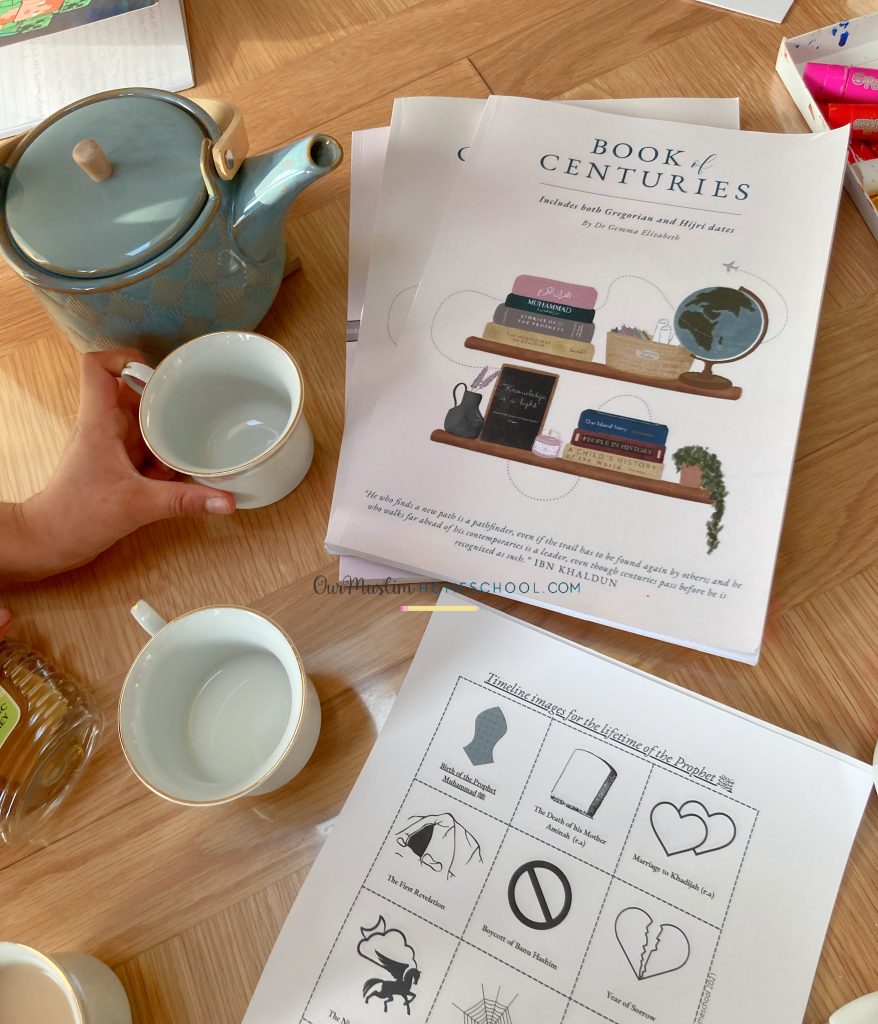
To ground this learning, we use a Book of Centuries: a personalized, blank timeline book where a child records major events, key figures, and scientific discoveries as they encounter them over the years.
Because I struggled to find one that fit the worldview of a Muslim family, we actually created and published our own! Our Book of Centuries includes the Hijri calendar side-by-side with the Gregorian calendar. It allows your children to see exactly what was happening in the Islamic world at the exact same time major events were unfolding in European or world history. Buy it here: https://amzn.to/4ouRXes (aff.)
Alongside this, my children produce their own notebooks. We step completely away from dry, consumable worksheets that treat history like a transactional test-prep subject. 📝🙄 Worksheets require zero imagination and usually end up in the bin. Instead, give your child a blank journal. Let them write summaries, draw maps, or sketch historical clothing. What goes onto those pages reflects their unique imagination and personal connection to the story.
Building an Unshakeable Islamic Identity
Finding high-quality Islamic history resources written in English can be a real struggle. However, there are some beautiful living books out there right now that are making a massive difference:
For Scholars & Predecessors: I absolutely love the biographies being written about the Imams of Tarim called Awliya of the Ummah by Umm Layla.
For Younger Kids: The Hadi Twin Adventures by Anisa Rasul is fantastic for sparking early historical curiosity.
For the Seerah: Anything by Leyla Azam is a beautiful, classic addition to your bookshelf.
For Female Role Models:Sheikha Fatima Barkatulla and Sheikha Haifa Younis have both published phenomenal biographies of the female Sahabiyaat.
Knowing our Islamic history is the ultimate key to raising a strong Ummah. When our children know the incredible legacy they come from, they develop an unbreakable sense of identity. They won’t feel the need to hide their faith or apologize for who they are.
If you spend any time online looking for homeschooling advice, you’ve probably noticed that social media has split the community into two very loud, very extreme camps. It can feel almost impossible to figure out how to create a peaceful homeschool schedule when the algorithms constantly push you toward one of two conflicting lifestyles.
On one side, you have the “free-range,” ultra-crunchy mums who talk exclusively about the importance of play and letting the child take the lead. But if you watch their content for too long, there’s a subtle undercurrent of guilt; a heavy implication that if you introduce any formal structure or academics, you are somehow denying your child their childhood.
Then you scroll a bit further, and you hit the other camp. This side advocates for a rigid, highly structured, bookish approach. They have immaculate, color-coded schedules, and their message is just as intense: if you aren’t hitting every academic benchmark right on time, you are essentially guilty of educational neglect.
There is almost zero space for intelligent, nuanced dialogue on social media about this. In fact, platforms intentionally push this division because extreme views get more clicks, more engagement, and more eyes. No wonder you’re feeling a little confused, guilty, or completely paralyzed about how to actually get anything done in your homeschool!
Recently, I received a message from a homeschooling parent that cut right through all this online noise. It truly resonated with my heart:
“The area of homeschooling that I need most help with is creating a schedule where the flow of work is comfortable, yet still meets our goals and requirements for advancement.”
First of all, Jazak Allah khair for sending this in. If you are reading this right now and nodding your head, please know you are not alone. It is the ultimate homeschooling tightrope walk, isn’t it? We want that peaceful, loving home environment that honors childhood—not a stressful, tear-filled classroom. But we also have real goals, curriculums to finish, and the responsibility of ensuring our children advance.
How do we marry the two? How do we find that middle path that flows beautifully but still gets the job done?
The reason this middle path is so hard to find is that the moment we actually try to sit down and get that structured work done, we run into a major roadblock: our children’s focus.
We plan a beautiful lesson, but within five minutes, our child is daydreaming, resisting, or melting down. And in that moment of frustration, we feel forced into those social media extremes—we think we either have to become a rigid drill sergeant to force them through it, or give up entirely and become a completely free-range homeschooler.
But if you feel like your child is struggling to stay focused, I want to give you some major reassurance: it isn’t just you, and it isn’t a failure of your scheduling. It’s a massive societal shift.
Recent data from right here in the UK paints a staggering picture. A major study surveying primary school teachers in England revealed that a massive 84% of educators believe children’s attention spans are shorter than ever before. In fact, things have changed so drastically in modern classrooms that one in five teachers report they now have to cut lesson activities down to under 10 minutes just to keep pupils from completely tuning out. [1] [2]
Educators point the finger directly at our “ever-swiping” digital culture. When young brains are conditioned by fast-paced screens and instant rewards, sitting down for a long, traditional school lesson feels painfully boring to them. Their brains are being rewired to seek quick bursts of stimulation, which leads directly to daydreaming, restlessness, and frustration when it’s time to do desk work.
So, how do we combat this modern “attention crisis” without causing tears at the kitchen table?
We don’t do it by forcing them to sit still for hours or fighting against their biology; we do it by working with it. And to do that, we can look at some incredible tools inspired by the 19th-century British educator Charlotte Mason, who famously argued that “the lessons must be short, fresh, and varied” to keep a child’s mind truly alive.
The Power of Short Lessons for a Peaceful Homeschool Schedule
Isn’t it fascinating that modern UK teachers are cutting activities to under 10 minutes out of desperation, yet over a century ago, Charlotte Mason was already advocating for this exact strategy?
When we think of academic advancement, we often think we need to sit a child down for an hour of math or 45 minutes of grammar. But Charlotte Mason observed that a child’s sustained, intense attention is a finite resource. For younger children (around ages 6 to 9), she advocated for lessons lasting just 10 to 15 minutes. For older children, 20 to 30 minutes.
Now, you might think, “How can they possibly learn enough and advance in 15 minutes?”
Here is the secret: Habit training. When a child knows a lesson is short, they give it their absolute, undivided attention. They don’t have time to dawdle or get fatigued. A child who works with intense focus for 15 minutes will often accomplish more than a child who stares at a worksheet for an hour while crying.
The Productivity Science: Parkinson’s Law & Pomodoros
Think about how we operate as adults. You might have heard of Parkinson’s Law—the idea that work expands to fill the time we give it. If you give yourself three hours to clean the kitchen, it will take three hours. If you give yourself 30 minutes because guests are arriving, you’ll get it done in 30 minutes!
Children’s brains work the exact same way. If they see a massive, never-ending pile of worksheets, their brain slows down to stretch the work out. But if we use what modern productivity experts call the Pomodoro Technique: working in short, intense bursts followed by a break…the brain sharpens.
By keeping lessons short, you are essentially using a child-friendly Pomodoro timer. You prevent burnout and you preserve their love for learning.
And how do we advance? Through consistency. Fifteen minutes of focused math, five days a week, adds up to massive progress over a year.
But how do you transition between these short lessons without the day feeling chaotic? Miss Mason suggested alternating the types of brain cells being used. If you just did 15 minutes of intense mental math, don’t move straight to handwriting. Instead, follow math with something creative or physical, like a handicraft, a nature walk, or reading a beautiful poem. This variation acts like a breath of fresh air for their brains.
Morning Baskets & Loop Scheduling in a Peaceful Homeschool Schedule
If lessons are short, that means you can technically fit in more subjects, like poetry, picture study, Quran, history, and science. But how on earth do you fit all of that into a day without feeling rushed?
This is where two brilliant scheduling tools come into play: the Morning Basket and Loop Scheduling.
1. The Morning Basket
This is a practice where the whole family gathers at the start of the homeschool day to share in what Charlotte Mason called “the feasts of education.” Instead of everyone scattering to their separate workbooks immediately, you start together with beauty, faith, and connection.
In a Muslim homeschool, this is the perfect time for your:
Morning Adhkar
Quran recitation
Stories of the Prophets
Poetry or a family read-aloud
A quick artist or picture study
The Morning Basket warms up everyone’s brains, grounds the day in the remembrance of Allah, and ensures that those “extra” subjects that feed the soul actually happen, comfortably, before the heavy individual work begins.
(Note: If you want to know more about the morning basket, I did a video years ago on YouTube that you can search up called “Our Muslim Homeschool morning basket.”)
2. Loop Scheduling
Once your Morning Basket is done, how do you handle the rest of the subjects without feeling chained to a rigid clock? You enter Loop Scheduling.
Traditional school schedules say: “It is Tuesday at 10:00 AM, so we must do History. If we miss it because we had an appointment, we are behind.” That rigid structure causes so much anxiety. Loop scheduling completely flips this. Instead of assigning a subject to a specific day and time, you create a list of subjects and simply “loop” through them in order.
Imagine your loop looks like this:
History
Science
Geography
Handicrafts
On Monday: You do your core work (like Math and Reading), and then you look at your loop. You have time for History. Great! Check it off.
On Tuesday: Life happens. A dentist appointment runs late, or the toddler has a meltdown. You only have time for core work, and you don’t even touch the loop.
On Wednesday: You open your loop again. You don’t stress about what you missed on Tuesday. You simply look at the next item on the list, which is Science.
Do you see the absolute freedom in this? You are never “behind.” You simply pick up exactly where you left off. It guarantees that you will advance through all your subjects at a comfortable, natural flow, while giving you the flexibility to handle real life. (This is also something that I teach in-depth inside Launch Your Homeschool.)
A Peaceful Homeschool Schedule will fill their buckets!
Dear sisters, meeting your educational goals doesn’t require a rigid, drill-sergeant mentality. True academic advancement happens through the quiet, consistent accumulation of small, faithful efforts.
The wonderful homeschool author Cindy Rollins often talks about education using the metaphor of an old poem—reminding us that little drops of water and little grains of sand are what eventually make the mighty ocean and the pleasant land. She writes in her memoir:
“You are never going to have a lot of time, but you do have a little time here and a little time there, and those little times all add up to a life.”
Your homeschool day is made up of exactly that: little drops.
By using short lessons to build the habit of attention, grounding your morning in connection, and using loops to give your day flexibility, you are dropping those little bits of beauty and knowledge into their buckets every single day. Over ten or twelve years, those little drops add up to a magnificent education. You can achieve an academic flow that feels like a mercy, not a burden.
What does scheduling look like in your home? Are you team “rigid calendar” or team “free-range”? Or something in between? Let me know in the comments below!
Homeschooling in your 40s doesn’t just feel busy; it feels heavy. Between the brain fog, the fatigue, and the “random” symptoms of perimenopause, the way we homeschool has to change.
“I feel like a piece of elastic that has been stretched and stretched and now has no more stretch, and cannot spring back.” – Nella Last 1945
If you’re feeling overstretched, here is the good news: Homeschooling in your 40s can actually be your best season yet.
When we are younger, we often “spoon-feed” our kids. We explain everything, dissect every book, and run ourselves ragged.
Perimenopause forces us to stop.
When your energy is low, you have to step back. This isn’t “lazy”—it’s effective. By moving away from over-teaching, you allow your children to:
Develop intellectual muscles by grappling with books themselves.
Become independent thinkers rather than just “parrots.”
Build a real relationship with their subjects without us standing in the middle.
The Silver Lining of the 40s
This decade brings a “Second Spring.” You finally gain:
Perspective: You know the “crises” of the early years always pass.
Freedom: You stop caring what the “perfect” homeschoolers are doing.
Clarity: You trade dry academics for life skills and meaningful physical activity.
3 Tips for This Season
Prioritize Health: Walking, sleep, and supplements are now non-negotiables.
Outsource: Let go of the ego that says you must teach every subject yourself.
Choose “Open & Go”: Switch to resources that require zero preparation from you.
Important Links & Resources
⭐️Our Sponsor:THE FUTURE EXPLOERERS CLUB – https://ourmuslimhomeschool.com/explorers ⭐️ Use code RAISINGMUMS5 for £5 off your subscription. (Perfect “Open & Go” Geography!)
Be kind to yourself, Sis. Your homeschool might look slower and quieter now, but it is likely becoming deeper and more full of barakah than ever before.
Is homeschooling in your 40s looking different than you expected? Share your thoughts in the comments!
Homeschooling socialisation is one of the most common comments or questions parents receive. Almost every argument involving homeschooling revolves around this: “Homeschooled children don’t get enough socialisation.”.
Nobody ever worries about whether our children will get a good education at home, but we hear a lot about children needing school for socialisation. It is a well-known fact that homeschoolers have been subjected to the socialisation argument for quite some time, but what is the reality in relation to homeschooling socialisation?
In Episode 93 of the Raising Mums podcast, I discuss homeschooling socialisation.
Homeschooling and Socialisation References:
The Prophet ﷺ was reported to have said, “I have been sent to perfect good character.” [al-Muwaṭṭa’ 1614, Sahih]
The Prophet ﷺ was reported to have said, “A man follows the religion of his friend; so each one should consider whom he makes his friend” [Abu Dawud]
“He who walks with the wise grows wise, but a companion of fools suffers harm.” [Proverbs, 13:20]
Study by Shyers, Hedin, Montgomery et al. showed a significant advantage seen in homeschooled kids, with regards to their social development.
Thomas Smedley (1992), in a controlled study, found that “…home educated in this sample were significantly better socialized and more mature than those in public school.”
When homeschooling you have the best intentions, but sometimes you wonder if you’re going to make it. Does your homeschool have a chance of success? How are you going to make it work, or even if you will fail?
You know how homeschooling benefits your kids and provides them with an excellent education. You’ve found advice on choosing curriculum, learning styles, methods of homeschooling, and setting up a schedule. But have you ever been told what personal qualities YOU NEED to succeed?
In Episode 92 of the Raising Mums podcast, I share how to successfully homeschool.
Enough to Homeschool is a 5-day virtual workshop with Dr. Gemma, for the mother who is ready to feel like a homeschooler.
Homeschooling success depends on the mother’s emotional regulation.
The curriculum she picks, her daily routine, and her knowledge of education are helpful. But, if she cannot see through the fog of her emotions, she will not be able to see the truth of what her children need, how to best educate them, and will struggle to enjoy the privilege that is home education.
Unlock your confidence and step into your role as a home educator!
The Enough to Homeschool 5-day workshop will take place 10-14th October 2022.
Although you know exactly what you should be doing at a particular moment, on a specific day of your homeschool, do you still struggle to accomplish it? There are times when even the best-laid homeschool plans don’t work out. When this happens, it can leave you feeling stressed and anxious.
All of us have done it. Despite creating seemingly perfect plans, they get discarded after a few weeks. How come we spend so much time creating plans and then have trouble sticking to our homeschool plans?
In Episode 90 of the Raising Mums podcast, I share how you can stick to your homeschool plans.
Points to be taken away:-
The initial period requires some experimentation and time to figure things out. It’s ok if you don’t get it right the first time!
Are you being over ambitious or unrealistic considering the season of life you find yourself in
Do you tell yourself you never follow through on things? Do you tell other people you can’t stick to plans? If you want to, you’ll need to change that part of your identity!
Play-based learning is so much more than just having fun for children; it is also a great way for them to learn. During childhood, play plays a significant rolein the development and health of children and their long-term success in learning and life. It is through play that competence is built in many domains. As children play, they are able to address social problems, solve problems solve and invent scenes and stories.
Pey Abdulwahid speaks about the importance of preserving play and wonder in childhood and gives advice to mothers who want to give their children more freedom when playing.
In Episode 89 of the Raising Mums podcast, I talk to Pey Abdulwahid about play-based learning.
Pey is a mum of 3 little kids (5 and under). She is interested in psychology, neuroscience and anything parenting and early childhood development, and of course, Islam. She likes to wrap gifts, cut, doodle, and do anything crafty and she also loves going to the beach and swimming.
Although the idea of getting ready to start homeschooling can be overwhelming, know that you can do it. Your first year of homeschool planning does not have to be overwhelming or frightening.
In Episode 88 of the Raising Mums podcast, I share what subjects you need to start with and show you the Easiest way to begin your Homeschool Planning!
This episode includes a clip from Day 2 of our recent 5-day Bootcamp – Start Your Homeschool Strong!
Although The Start Your Homeschool Strong Bootcamp is currently closed, Launch Your Homeschool students will be given access to the full boot camp.
Launch Your Homeschool is now open now and closes Friday 5th August, 2022 at 9pm (UK).
Launch Your Homeschool is an online course that will hold your hand and walk you through the beginning stages of homeschooling, built upon the framework of the Charlotte Mason philosophy.
I teach you how to choose the right subjects for your homeschool, how to choose the right resources, and plan out your year to create a homeschool experience that aligns with the values and beliefs of your family. Whether you are homeschooling in the UK, or elsewhere in the world, this programme will help you give your children an incredible education at home.
I show you the essential teaching techniques that you’ll need to know to get started. There’s even an entire module on how to manage your time so you can still cook, keep the house tidy and take care of yourself, all whilst homeschooling your children!
Several reasons exist for parents to not send their child to public schools, such as dissatisfaction with the curriculum, teaching methods, and religious concerns, but is homeschooling really better? Khadijah Stott-Andrew addresses this concern and her realisation that teachers don’t have all the answers either.
Khadijah is a mother of three and a self-proclaimed bookaholic! She talks about homeschooling while moving house and also how she has combined the national curriculum with the Charlotte Mason philosophy.
In Episode 87 of the Raising Mums podcast, I talk to Khadijah Stott-Andrew from Our Daily Wonders.
Launch Your Homeschool is an online course that will hold your hand and walk you through the beginning stages of homeschooling, built upon the framework of the Charlotte Mason philosophy.
I teach you how to choose the right subjects for your homeschool, how to choose the right resources, and plan out your year to create a homeschool experience that aligns with the values and beliefs of your family. Whether you are homeschooling in the UK, or elsewhere in the world, this programme will help you give your children an incredible education at home.
I show you the essential teaching techniques that you’ll need to know to get started. There’s even an entire module on how to manage your time so you can still cook, keep the house tidy and take care of yourself, all whilst homeschooling your children!